

The Convergence of Spaces.
Artificial Intelligence changed how machines think. Physical AI is changing how machines interact with the world.
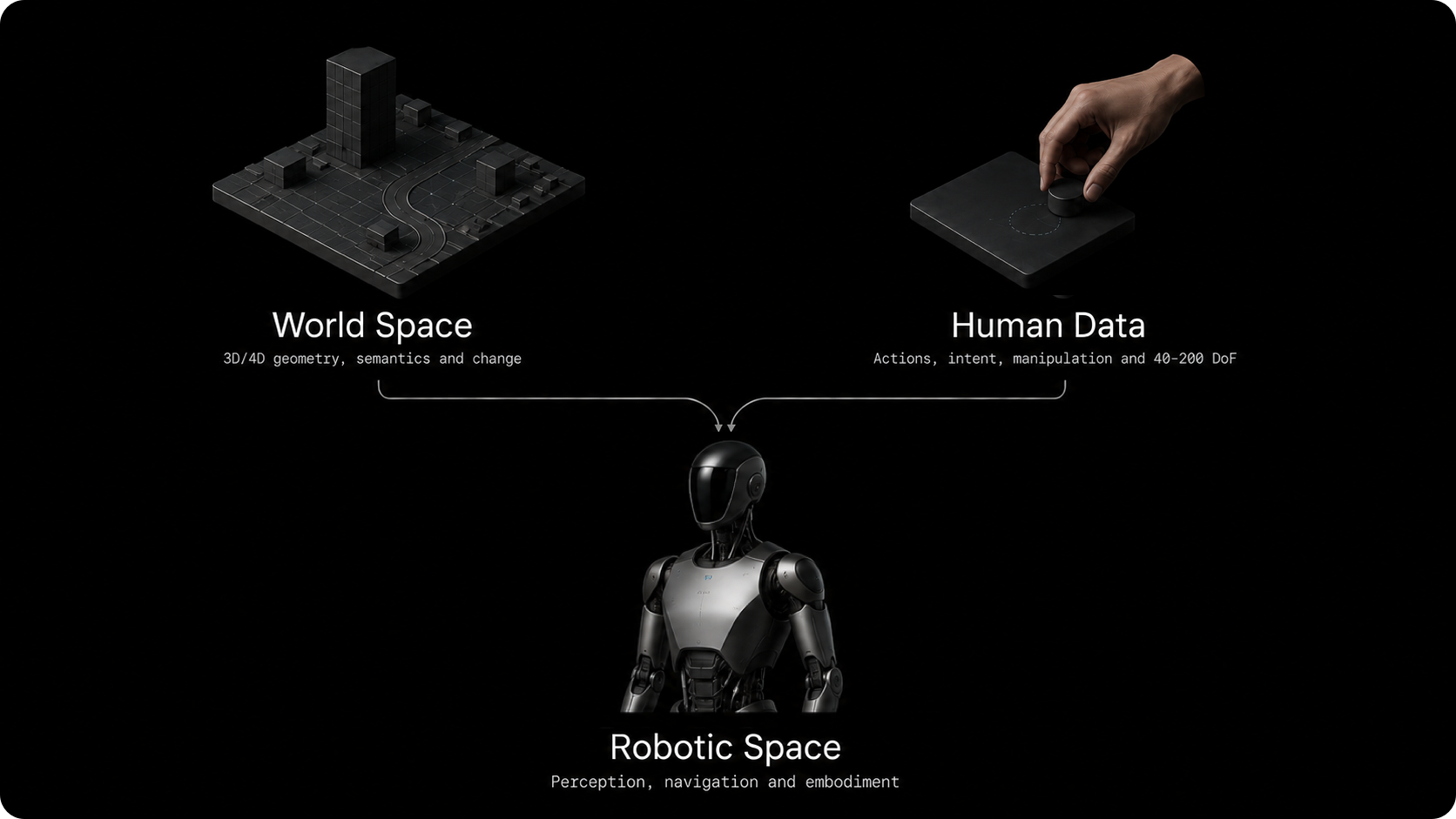
Separate data domains must become one.
For decades, robots have been trained using separate types of data. Maps taught them where they were. Human demonstrations taught them what to do. Sensor data helped them perceive their surroundings. These datasets existed independently because robots were designed to solve isolated problems.
The next generation of intelligent machines is different.
Humanoid robots, autonomous vehicles, drones and mobile robots must simultaneously understand the world around them, interact safely with people, manipulate objects and continuously adapt to changing environments. To achieve this, these separate data domains must become one.
We call this The Convergence of Spaces.
Everything a robot needs to understand its environment.
It includes high-definition 3D and 4D representations of the physical world, semantic understanding of roads, buildings, objects and infrastructure, localisation, environmental context and the ability to understand how places change over time.
This is the foundation that allows robots to perceive and navigate reality.
Everything a robot needs to understand human activity.
It includes human movement, physical manipulation, workflows, interactions between people and machines, object handling, behavioral understanding, communication, audio, intent and the countless real-world tasks that robots must eventually perform.
This is how robots learn to work alongside people.
True Physical AI emerges when these two worlds converge.
A robot should not simply know where an object is. It should understand what the object is, how people interact with it, when it should be manipulated, how it should be moved, what sounds are associated with the task and how the surrounding environment influences every decision.
When World Space and Task Space are connected, robots no longer learn isolated skills.
They learn within context.
This convergence creates what we call Robotic Space: a unified representation of the real world where perception, navigation, interaction and physical tasks are all connected. It is the environment in which intelligent robots can truly understand, reason and act.
The future of robotics will not be built on static datasets.
The physical world changes every day.
Roads and cities are rebuilt. Buildings appear. Furniture moves. Human behavior evolves. New objects are introduced. Workflows change.
The data powering Physical AI must evolve just as quickly.
Our vision extends beyond collecting data. We are building a continuously refreshed, governed and scalable data infrastructure that enables robots to learn from an ever-changing world.
This is the foundation that allows Physical AI to generalize beyond individual demonstrations, adapt to new environments and continually improve over time.
By combining World Space and Task Space into a single, continuously evolving source of real-world intelligence, we give robots the context they need to perceive, understand and perform useful work.
This is the Robotic Data Thesis.
And it is the future of Physical AI.